Stumbling Over the Manger – Part 2
In last week’s blog, we looked at how the manger can become a stumbling block because of its indictment of our sinful nature and our deep brokenness that can only be healed through the coming of God in the flesh. For those who don’t believe they need anyone to save them, or who carry too much anger to hear the message, the little babe in the manger will not bring hope, peace, or joy.
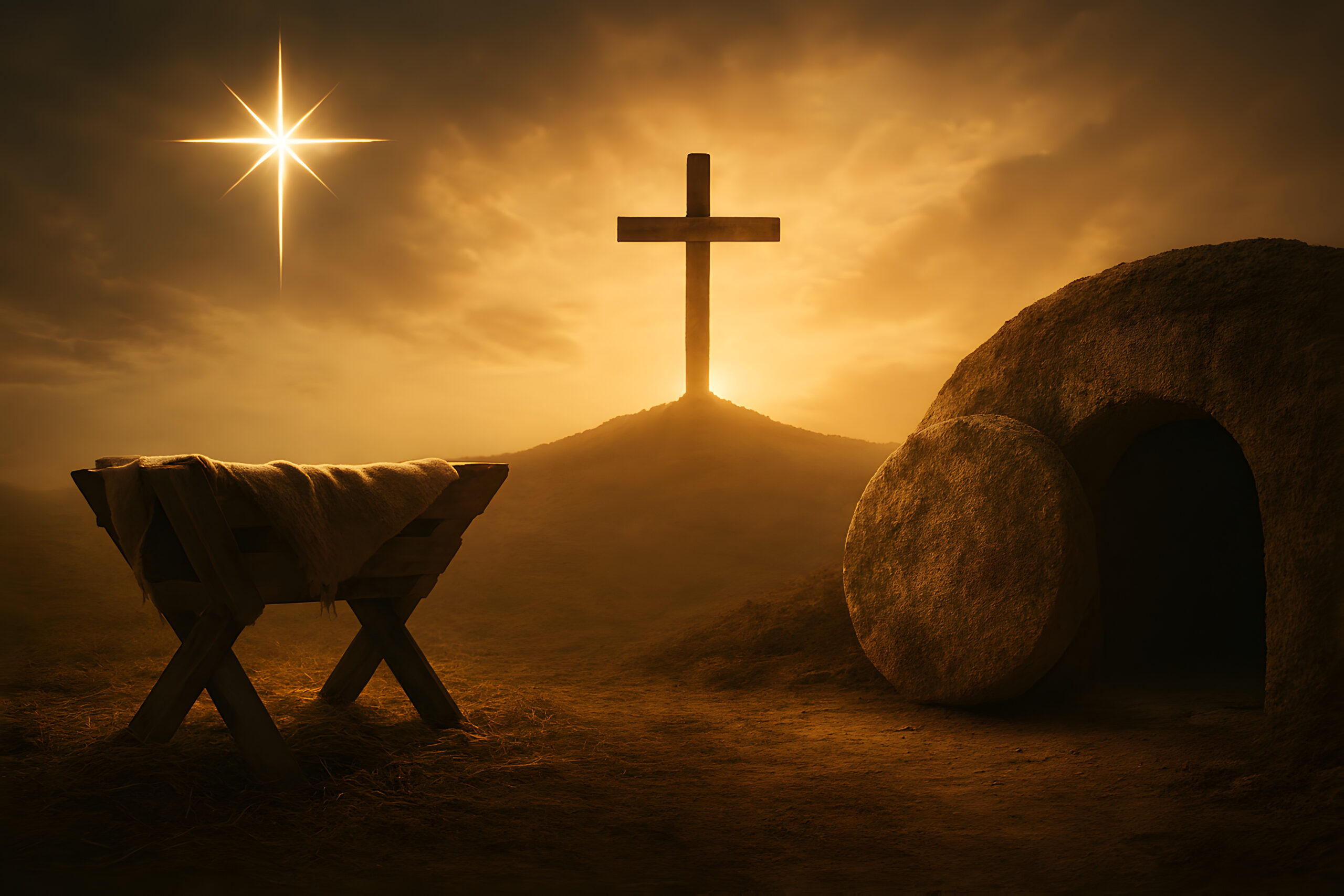
This week we turn to the second truth that will cause so many to stumble over the manger; you cannot separate the cradle from the cross. I saw a powerful image of this where the bright beams from the Bethlehem star shown through the top of the stable and two boards formed the shadow of a cross that fell across the sleeping baby in the trough. We try to capture this imagery by saving our Christmas tree each year, then for Lent we trim its branches, cut the trunk in two and create a cross. That cross is displayed in the very center of the area our nativity scene now occupies. This is a reminder that Jesus became flesh and dwelt among us for one reason, to proclaim the coming of the kingdom of God that would be available for all who would accept the forgiveness that was won for them in the bloody, torturous death of Jesus on the cross of Calvary.
That’s what jars us. That’s what disturbs our modern-day senses. This collision of two images from which we must not shrink back when we come to the manger; the innocent baby in the cradle, and the flogged, beaten man brutally nailed on the cross.
“She gave birth to her firstborn, a son. She wrapped him in cloths and placed him in a manger.” Luke 2:7
“He was pierced for our transgressions, he was crushed for our iniquities; the punishment that brought us peace was on him, and by his wounds we are healed.” Isaiah 53:5
For many, those two images simply cannot be tolerated together. Why would God have to exact such punishment just to forgive us? Why the sacrifice? Why the brutality? Why the blood? Why the cross? If the birth of the child required all of this, it is too much for some people to handle. And they will stumble over the manger.
We must be very careful and precise in our response to these stumbling blocks. We must start by correcting the misguided idea that the wrath of the Father required the brutal death of the Son to appease his anger toward us. We split the Trinity when we talk of such a Father who sits in judgment on a throne and demands his Son be sent to the cross so that this absentee Father can finally be brought to a place of mercy and offer forgiveness. This is a wholly un-Christian, un-biblical understanding of both the incarnation and the crucifixion.
If we truly believe in a triune God, then we cannot attribute God’s wrath towards sin to only one person of the Trinity. If we’re going to talk about the wrath of the Father, we have to talk about the wrath of the Son, and the wrath of the Spirit. Hatred of sin and its soul-destroying effects on us is a shared hatred by a triune God. In the same way, the price to be paid for defeating sin and evil was a triune commitment. The incarnation was not some fallback plan when the original strategy in Eden failed. It was not a reaction. The lamb was slain from the foundation of the world. (Revelation 13:8) Before our triune God uttered the words “Let there be light” (Genesis 1:3), there was a pre-creation commitment to this moment. To the incarnation of God in the flesh. To Bethlehem. To Galilee. And to Calvary. Creation was a trinitarian act. Defeating sin and evil is a trinitarian commitment. The cross and the salvation it brings is a trinitarian event. And our life in the Spirit that empowers us to follow Jesus under the overwhelming love of the Father is a trinitarian life.
The kingdom of God that Jesus proclaimed was the kingdom of our triune God. Unless we understand the triune nature of the entire salvation history of humanity, we will be tempted to accept the baby in the manger but reject the idea of his sacrifice for our sins. In doing so we vacate the incarnation of its meaning and power, and stumble over the manger.
There’s a second question that is a stumbling block to so many. Why was the cross needed at all? And for this, we must start with the absolute perfect justice of God. When humanity fell into sin, we became responsible for its consequences. God in his mercy gave us every chance to show our ability to live blameless lives and return to Him with our whole heart. But the history of humankind has proven unequivocally that, “all have sinned and fallen short of the glory of God.” (Romans 3:23) As we learned last week, we have no ability to save ourselves, to atone for our sins, or to put ourselves in any way in a position before God where we are not found guilty and condemned under our sinfulness. So how does a holy and perfectly just God deal with the consequences of his creation that has wholly rejected him? Couldn’t he just forgive us because he loves us?
Imagine the scene in a courtroom. A man is found guilty of a heinous crime. There are victims who are deeply wounded, and a jury has unanimously convicted him. The judge, however, smiles benevolently and proclaims that this is really a good man and in the end he’s sorry for what he did so he’s going to let him go. Is that justice? Or another man is charged with embezzling millions of dollars from elderly people, depleting their pension funds and leaving them penniless. He’s found guilty of the crime and confesses to it. At the time of sentencing, the judge smiles and says, “Well you know, this man really is sorry for what he did, so we’re just going to forgive him and let him go.” No requirement to repay. No restitution required. Would you say that justice was served? Our entire legal system, even in our fallenness, is based on consequences for our bad decisions. A person may fall on their knees and repent of their crimes before the judge, but they still go to prison, pay restitution as needed, and feel the consequences of their sin. How much more unjust would God be if he simply forgave us? And what would keep us from continuing in our life of sinfulness once he did?
No, the holy justice of God requires that there will be a price paid for sin. We pay it in small ways every day when we reap the consequences of our life’s bad decisions. However, on a much larger, cosmic level, the mass sins of all humanity are far too much for any person or persons to bear away. There was only one possibility, one hope for us. That God himself would take on our collective humanity, which included all sin for all time and defeat it once and for all in the ultimate sacrifice. Taking our place, bearing our sin, standing under God’s judgment, the horror of the cross was necessary to win our forgiveness. Remember again, it was the wrath of the triune God against sin that formed the commitment to the cross in the center of the Trinity before creation began. It was the love of the triune God, Father, Son, and Holy Spirit, that carried out the sacrifice. It was said of Jesus, “For the joy set before him he endured the cross.” (Hebrews 12:2) And it is now the grace and mercy of our triune God that offers to us the opportunity to live as the new creation, as citizens of a new kingdom.
In the middle of our dark and broken world, we can live a life in all this fullness as we bear the image of this triune God in all we do. That is what is offered through Jesus Christ. And it all began at the manger. Stumbling over the manger because of a false view of the cross is perhaps one of the saddest things that will happen this Christmas season. When, however, we hold cross and cradle together, when the shadow of the cross lays across the babe in the manger, when we do not look away from the two tiny infant hands raised toward his mother and see in them the same two hands stretched out on the cruel tree, we will experience afresh the inexpressible truth of Christmas. Immanuel – God with us, the hope of glory!